

Trauma, Digital Readiness and Confidence in SUMIT’s Second Community of Practice
This QCAPTURE showcases the second Community of Practice event of the SUMIT (Substance Use and Mental Health Interventions using Digital Technology) that took place in Drogheda.
The Community of Practice was hosted by our community partner, The Red Door Project. Building on the foundations laid out in the inaugural Community of Practice (CoP), this session moved beyond conceptual aspects to begin to explore how trauma-informed and digitally enabled practice can be operationalised within partner services across Northern Ireland and the Republic of Ireland.
Reframing Co-Design: Enhancement Rather Than Innovation
Initial conversations in the CoP focused on changes that had arisen since CoP1, and any aspects of SUMIT that services were looking forward to; or aspects which they had concerns over. The mood among attendees was positive, with a sense of optimism and momentum building in organisations.
One key consideration for this was the positioning of co-design not as product development, but as service enhancement. Partners reflected that the recent SUMIT work focusing on existing workflows and considering points in existing service provision where digital augmentation can strengthen delivery was key to mindset change around digital service enhancement.
This reframing was reported to have reduced organisational anxiety associated with large-scale digital transformation. Instead of pursuing bespoke technological solutions, services were encouraged to consider adaptation of existing or “off-the-shelf” tools, situating digital change within existing operational cultures. The support provided through SUMIT was also valued by partners.
However, concerns were also highlighted around managing organisational change that may be required with the addition of ‘digital’ into existing systems. GDPR and aligned governance aspects were reflected as potential challenges. Changing patterns of substance use, need for cultural competence, and social exclusion were also highlighted as issues which should be considered.
Trauma-Informed Practice: Individual competence to organisational design
The trauma-informed deep dive led by Professor Anne Campbell emphasised the need to shift from practitioner-level competencies to system-level embedding.
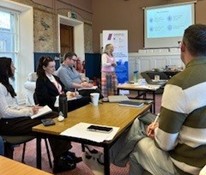
Through discussions, parallels were drawn between communities in Northern Ireland living with the legacy of the Troubles and communities in Drogheda shaped by more recent gang-related violence. Although historically distinct, both contexts exhibit cumulative trauma impacting trust, engagement and service uptake. Anne took time to frame the possible trauma informed training offering from SUMIT, asking for services input to clarify what would be most appropriate for all.
Digital readiness, inclusion and governance
The session on digital readiness, was delivered by Aaron Slater from SCVO (Scottish Council for Voluntary Organisations) who used a case study to illustrate the importance of digital readiness from the organisational perspective. The session focused on reducing anxiety and clarifying support that is available through SUMIT for Community partners undertaking their own digital journey.
The case study highlighted missed opportunities in supporting service users experiencing online hostility, including limited proactive guidance around privacy settings and digital boundaries. Discussion of digital inclusion challenged the “digital champion” model. Consensus emerged that digital inclusion must be distributed across teams rather than assigned to a single individual.
From Reflection to Applied Learning
CoP 2 served to generate structured outputs including practice insights, identified organisational support needs, and explored further digital support offers. SUMIT’s second Community of Practice demonstrates how evidence-informed dialogue can move beyond the conceptual, embedding trauma-informed and digitally supported principles into the operational realities of service provision.
One of the most important aspects that emerged from CoP2 was confidence: Confidence that co-design can be proportional and practical; Confidence that digital change can align with trauma-informed values; Confidence that partnership and shared learning is the most productive route forward.
As one participant reflected in closing: “The tools are already here. The challenge is making sure they work for people, not the other way around.”